

Mental Health Screening Month: A Simple Check-In With Yourself
It is not always easy to recognize when stress, sadness, worry, or exhaustion has become something more. You may still be going to work, caring for other people, and completing what needs to get done while quietly feeling unlike yourself.
A mental health screening can offer a place to begin.
October is recognized as National Depression and Mental Health Awareness and Screening Month. With Mental Illness Awareness Week taking place during the first full week of October and World Mental Health Day observed on October 10, this month offers a meaningful opportunity to check in with yourself and recognize symptoms that may have been easy to dismiss.
Brief questionnaires such as the PHQ-9 for depression and the GAD-7 for anxiety ask about symptoms you have experienced recently. Your answers produce a score that can help identify patterns and indicate whether speaking with a mental health professional may be helpful.
A screening cannot diagnose a mental health condition. It can help you pause, take your experiences seriously, and decide what to do next.
What Is a Mental Health Screening?
A mental health screening is a brief set of questions designed to identify symptoms that may be associated with a mental health condition. Screenings are commonly used in primary care, behavioral health programs, schools, community organizations, and other settings.
Most screenings ask how often you have experienced certain symptoms during a specific period. These may include changes in:
- Mood
- Interest or motivation
- Sleep
- Energy
- Appetite
- Concentration
- Self-worth
- Worry
- Restlessness
- Irritability
- Ability to relax
A score is calculated from your responses. That score can help show whether your symptoms fall within a minimal, mild, moderate, or more severe range.
The result is a starting point, not a final answer.
What Can a Mental Health Screening Tell You?
A screening can help you recognize that what you are experiencing deserves attention.
It may help you:
- Identify symptoms you have been minimizing
- Notice patterns across several areas of daily life
- Understand the general severity of current symptoms
- Put difficult experiences into clearer language
- Prepare for a conversation with a healthcare professional
- Track changes in symptoms over time
- Decide whether a more complete evaluation may be appropriate
A result may also validate something you already suspect. If you have been telling yourself that you should simply push through, seeing your experiences reflected in a structured assessment can make it easier to acknowledge that additional support may be needed.
What Can a Mental Health Screening Not Tell You?
A screening cannot determine on its own whether you have depression, an anxiety disorder, trauma-related symptoms, or another condition.
It cannot fully account for:
- Your personal and family history
- Recent loss, trauma, or major life changes
- Physical health conditions
- Medication side effects
- Alcohol or substance use
- Sleep disorders
- Hormonal changes
- The safety and stability of your environment
- How symptoms affect your relationships and responsibilities
- Whether multiple conditions are occurring together
Different concerns can also produce similar symptoms. Poor concentration, for example, may be connected to depression, anxiety, ADHD, trauma, sleep deprivation, substance use, medication, or a medical condition.
A complete mental health evaluation looks beyond a score. It gives a qualified professional an opportunity to understand what is happening in the context of your life. Scottsdale Providence Recovery Center explains more about this process in its guide to what to expect from a mental health evaluation.
What Is the PHQ-9 Depression Screening?
The Patient Health Questionnaire-9, commonly called the PHQ-9, is a nine-question screening tool used to assess symptoms commonly associated with depression.
It asks about experiences during the previous two weeks, including:
- Limited interest or pleasure in activities
- Feeling down, depressed, or hopeless
- Sleep difficulties
- Low energy
- Appetite changes
- Feelings of failure or low self-worth
- Difficulty concentrating
- Moving or speaking unusually slowly, or feeling especially restless
- Thoughts of death or self-harm
Each response receives a score from 0 to 3, creating a total possible score between 0 and 27.
Score | General symptom range |
0–4 | None to minimal |
5–9 | Mild |
10–14 | Moderate |
15–19 | Moderately severe |
20–27 | Severe |
These ranges describe the level of symptoms reported. They do not provide a diagnosis by themselves.
A lower score also does not mean that your experiences are unimportant. A specific symptom may still require prompt attention, even when the overall score is relatively low.
What Is the GAD-7 Anxiety Screening?
The Generalized Anxiety Disorder-7 questionnaire, commonly called the GAD-7, is a seven-question tool used to screen for anxiety symptoms.
It asks about experiences during the previous two weeks, including:
- Feeling nervous, anxious, or on edge
- Difficulty controlling worry
- Worrying about different things
- Difficulty relaxing
- Restlessness
- Irritability
- Feeling afraid that something bad may happen
Each response receives a score from 0 to 3, creating a total possible score between 0 and 21.
Score | General symptom range |
0–4 | Minimal |
5–9 | Mild |
10–14 | Moderate |
15–21 | Severe |
The GAD-7 was developed to screen for generalized anxiety symptoms, but clinicians may use the responses as part of a broader conversation about anxiety and emotional health.
A score cannot explain why you feel anxious. That requires understanding your circumstances, health, history, and how your symptoms affect daily life.
Screening Tools Can Also Help Measure Progress
The PHQ-9 and GAD-7 are not only used to recognize symptoms. When administered at different points in treatment, they can also help clinicians and clients understand how self-reported symptoms are changing over time.
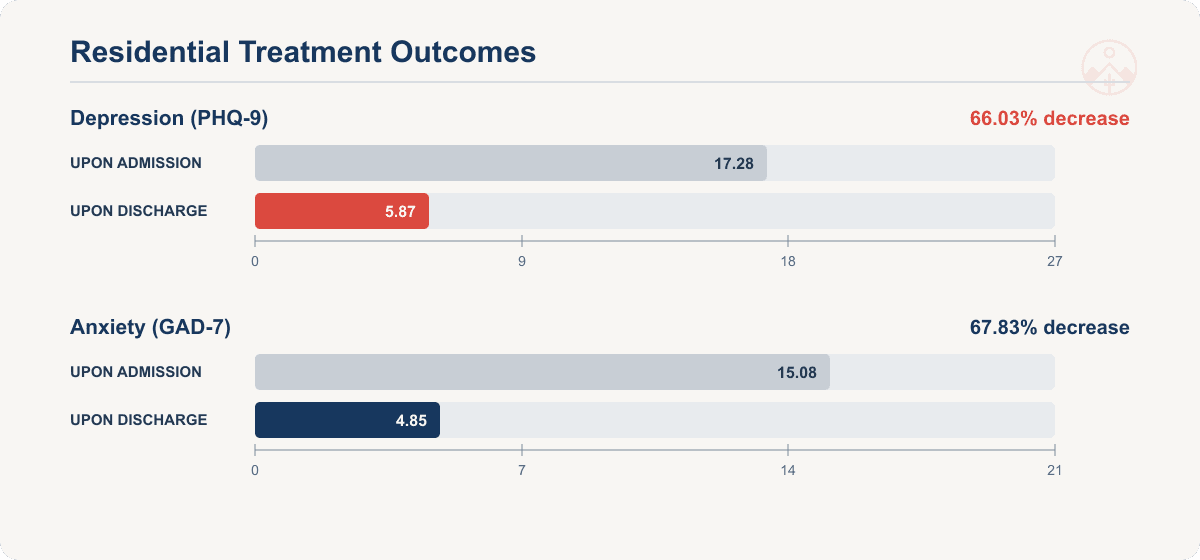
In a 2026 review of three years of outcomes from the 106 most recent residential clients at Scottsdale Providence Recovery Center:
- Average PHQ-9 depression scores decreased from 17.28 at admission to 5.87 at discharge, a 66.03% decrease
- Average GAD-7 anxiety scores decreased from 15.08 at admission to 4.85 at discharge, a 67.83% decrease
These results reflect average self-reported symptom changes across the residential sample. They do not predict how any one person will respond to treatment.
The findings show why structured measurement can be valuable. A score is not the whole story, but tracking the same symptoms over time can help make progress more visible and support
Readers can learn more about residential treatment and measured outcomes at Scottsdale Providence Recovery Center.
What Should You Do With Your Screening Results?
Your next step should be based on more than the number alone.
Consider:
- How long the symptoms have been present
- Whether they are becoming more intense
- How they affect sleep, work, school, relationships, or self-care
- Whether you are using alcohol or other substances to cope
- Whether you feel safe
- Whether the symptoms have occurred before
- Whether your current coping strategies are still working
If your score suggests mild symptoms, you may still benefit from speaking with a therapist, primary care provider, or another mental health professional. Early support can help before symptoms become harder to manage.
A moderate or high score generally deserves further evaluation, especially when symptoms are persistent or interfering with everyday life.
The goal is not to fit yourself into a category. The goal is to understand what you are experiencing and identify the type of support that may help.
What If Your Score Is Low but You Still Feel Like Something Is Wrong?
Trust what you are noticing.
Screening tools are brief by design. They cannot capture every mental health condition, personal experience, or form of emotional distress. They may not fully reflect trauma, grief, panic attacks, mood changes, obsessive thoughts, substance use, relationship violence, or the effects of prolonged stress.
People also interpret questions differently. You may underreport symptoms because you have grown accustomed to feeling a certain way or because admitting how difficult things have become feels uncomfortable.
You do not need a high score to deserve support. If something feels wrong, a conversation with a qualified professional is still appropriate.
What If a Screening Mentions Thoughts of Self-Harm?
The PHQ-9 includes a question about thoughts that you would be better off dead or thoughts of hurting yourself.
Any response other than “not at all” deserves direct attention, regardless of the total score. A screening result should never be the only response to possible self-harm or suicide risk.
If you are in immediate danger or believe you may act on these thoughts, call 911 or go to the nearest emergency department. In the United States, you can also call or text the 988 Suicide & Crisis Lifeline at 988.
If there is no immediate danger, tell someone you trust and connect with a licensed mental health professional as soon as possible. You do not need to wait for the thoughts to become more frequent or severe before asking for help.
Why Can Depression and Anxiety Be Difficult to Recognize?
Mental health symptoms do not always look dramatic from the outside.
Depression may appear as exhaustion, irritability, withdrawal, poor concentration, disrupted sleep, or a loss of interest rather than visible sadness. Anxiety may look like overpreparing, perfectionism, difficulty resting, physical tension, or constantly anticipating what could go wrong.
A person can appear productive and still be struggling significantly.
Symptoms may also develop gradually. When changes happen over several months, they can begin to feel normal. A screening provides a structured opportunity to notice what has shifted.
Scottsdale Providence Recovery Center offers mental health treatment for depression, anxiety, trauma, and other concerns when symptoms begin interfering with stability or daily life.
How Do Trauma and Substance Use Affect Screening Results?
Trauma, mental health, and substance use can overlap.
Alcohol or other substances may initially seem to quiet anxiety, improve sleep, or create distance from painful emotions. Over time, they can intensify mood symptoms, disrupt sleep, and make it more difficult to understand what is driving the distress.
Trauma can also affect concentration, energy, sleep, emotional regulation, and feelings of safety. Some of these experiences may appear in depression or anxiety screening results even when trauma is an important part of the picture.
This does not make the screening inaccurate. It means the score needs context.
Integrated evaluation can help determine whether symptoms are connected to depression, anxiety, trauma, substance use, or a combination of concerns. Scottsdale Providence Recovery Center’s dual diagnosis treatment addresses mental health and substance use concerns together rather than treating them as unrelated problems.
Is an Online Mental Health Screening Private?
Privacy depends on the website and how it collects, stores, or shares information. Before completing an online screening, review any available privacy statement and avoid entering identifying information unless you understand how it will be used.
A well-designed public screening should clearly explain:
- Whether responses are stored
- Whether personal information is required
- Who can access the results
- Whether the tool is educational or part of clinical care
- What happens after the screening is completed
- What to do if the answers indicate an immediate safety concern
An online screening should never imply that a computer-generated score is a diagnosis or a substitute for emergency care.
How Often Should You Take a Mental Health Screening?
There is no universal schedule for taking a mental health screening. It may be useful when:
- You notice a change in your mood or anxiety
- Symptoms begin affecting daily life
- You are going through a major transition, loss, or stressful period
- You want to prepare for an appointment
- A healthcare professional recommends monitoring symptoms
- You want to see whether symptoms have changed over time
Repeatedly taking a screening for reassurance can sometimes increase anxiety without providing meaningful clarity. If you remain concerned, speaking with a professional may be more helpful than continuing to retake the questionnaire.
A Score Is Information, Not Your Identity
A mental health screening can give language to experiences that have been difficult to explain. It can show that symptoms deserve attention and help make the next conversation feel more manageable.
It cannot define you, diagnose you, or tell your entire story.
Scottsdale Providence Recovery Center provides integrated care for mental health, trauma, substance use, and co-occurring concerns. If depression or anxiety is affecting your relationships, responsibilities, sleep, sense of stability, or ability to feel like yourself, you can speak with the admissions team about available support.
Frequently Asked Questions
No. A screening identifies symptoms that may warrant further attention. A diagnosis requires a more complete evaluation by a qualified professional.
Yes. A brief questionnaire cannot capture every experience or condition. Your functioning, safety, history, and personal concerns still matter.
Yes. Stress, grief, sleep disruption, medical conditions, substance use, trauma, and major life changes can affect the symptoms measured by these tools. A professional evaluation can help clarify what may be contributing.
The tools measure different groups of symptoms. Taking both may provide a broader view when you are experiencing changes in both mood and anxiety, but neither tool replaces a clinical assessment.
Not necessarily. A screening score alone cannot determine the appropriate level of care. Safety, symptom severity, daily functioning, home environment, substance use, treatment history, and support needs must also be considered.
The guide to residential versus outpatient treatment explains how these levels of care differ.
Screenings may be repeated during treatment to help monitor changes in self-reported symptoms. Clinicians interpret those changes alongside conversations, observations, functioning, safety, and other clinical information.

Author
Victoria Yancer
Victoria writes thoughtful, compassionate content for the behavioral health space. She brings clarity to complex topics and creates messaging that helps people feel informed, understood, and supported as they explore treatment options.

Clinical Reviewer
Daniel Nichols, LCSW
Dan is a Licensed Clinical Social Worker with over 17 years in behavioral health and addiction treatment. His trauma-informed approach blends evidence-based therapies with hope, purpose, and community.
Related articles

Anxiety vs Intuition: How to Tell the Difference
Is it anxiety or intuition? Learn how urgency, physical symptoms, trauma, and thought patterns can reveal whether fear or a gut feeling is guiding you.

A Community Honor: Scottsdale Providence Recovery Center Recognized by PHOENIX Magazine as Best Mental Health Facility
Scottsdale Providence Recovery Center, named Best Mental Health Facility in PHOENIX magazine’s 2026 Best of the Valley awards, thanks our community.

Men’s Mental Health Month: Why It Matters and When to Get Support
Men’s Mental Health Month raises awareness around depression, anxiety, trauma, substance use, and suicide risk. Learn the signs and when to seek support.

High Functioning ADHD in Women: Understanding the Hidden Struggle
High functioning ADHD in women often hides behind success, masking, and burnout. Learn the signs, why it is missed, and when to seek support today.