

Caregiver Burnout When Supporting Someone With Mental Illness or Addiction
You notice your phone before anything else. A missed call makes your stomach tighten. Even when things are going well, part of you is waiting for something to change.
You love this person. You may also feel angry, exhausted, frightened, or desperate for a few hours when nobody needs anything from you. Then the guilt arrives.
Caregiver burnout can develop when supporting someone else leaves too little room for your own health, relationships, and daily life. It can affect parents, spouses, siblings, partners, and close friends supporting someone with mental illness or addiction.
November is National Family Caregivers Month, a time to recognize the work families often do quietly. That includes the appointments, difficult conversations, interrupted nights, and worry that other people may never see.
Your exhaustion deserves attention, even if your loved one is still struggling.
When Helping Starts to Take Over Your Life
Caregiver burnout describes physical, emotional, and mental exhaustion associated with ongoing caregiving demands. It can develop when those demands exceed the time, resources, and support available to you.
You may not think of yourself as a caregiver. Perhaps you are the spouse who arranges appointments, the parent who answers late-night calls, or the sibling who keeps track of whether someone has eaten.

The role can grow gradually. A temporary responsibility becomes a daily expectation. You postpone your own plans because this week seems especially difficult. Eventually, you cannot remember the last time your schedule belonged to you.
Supporting someone with mental illness or addiction can involve uncertainty as well as practical work. You may be trying to understand symptoms, navigate treatment, manage financial strain, or decide when concern requires action.
Those responsibilities can be meaningful and exhausting at the same time.
Is It Ordinary Stress or Caregiver Burnout?
A stressful week may leave you tired but able to recover when demands ease. With caregiver burnout, you may feel persistently depleted, detached, or unable to meet the needs in front of you. A brief break may no longer feel sufficient.
You might still get everyone to their appointments and show up for work. Functioning does not necessarily mean you are doing well.
Consider what has changed:
- Are you getting opportunities to rest, or only pauses between responsibilities?
- Have your own appointments, friendships, and interests become optional?
- Does every request feel urgent, even when it can wait?
- Do you feel that stepping away would make you responsible for whatever happens next?
There is no precise line you must cross before asking for help. Family caregiver stress deserves attention before you reach a point where continuing feels impossible.
Caregiver Burnout Symptoms Can Show Up in Different Ways
Some signs are easy to recognize. Others may feel so familiar that you have started treating them as normal.
Emotionally, you may experience constant worry, irritability, resentment, sadness, or numbness. You might feel guilty after becoming frustrated or find that activities you once enjoyed no longer interest you.
Physically, you may struggle with disrupted sleep, fatigue, headaches, changes in appetite, or other persistent discomfort.
In your behavior, you may withdraw from relationships, neglect personal health, have difficulty concentrating, or use more alcohol or other substances to cope.
For families navigating mental health or substance use concerns, exhaustion may also appear as an inability to step away. You keep checking your phone, reviewing conversations, or wondering whether you missed a warning sign.
These experiences do not make you uncaring. They suggest that your own needs may have been pushed aside for too long.
Caregiver Burnout and Depression Can Overlap
Caregiver burnout describes exhaustion related to the caregiving role. Depression is a clinical condition that can affect mood, interest, energy, sleep, concentration, and functioning across your life.
You can experience both. Persistent low mood, hopelessness, or loss of interest should not be dismissed as “just caregiver fatigue,” especially when symptoms occur most days for two weeks or longer. A health professional can help assess what is happening; you do not have to wait two weeks if symptoms are severe.
Why It Can Be Hard to Stop Watching for the Next Crisis
After repeated urgent situations, an ordinary evening may not feel ordinary anymore. You may listen closely to someone’s tone, worry about an unanswered message, or hesitate to make plans away from home.
Perhaps there have been periods of improvement followed by worsening symptoms or a return to substance use. You want to feel hopeful, but you are afraid to relax.
That uncertainty can leave you trying to prevent every possible problem. You check more often, take on more tasks, and become increasingly exhausted.
A useful conversation with the treatment team is: What needs an immediate response, what can wait, and who should respond?
Clear guidance can help you distinguish an emergency from a difficult moment. Families should not have to improvise every response alone.
Support, Enabling, and Taking Responsibility Are Different
When you are worried about someone, it can be hard to judge whether helping is useful or whether you are taking on too much.
Support might include listening, helping arrange an assessment, providing transportation, or following a care plan developed with professionals.
The word “enabling” is often used for actions that unintentionally make harmful substance use easier to continue, for example, providing money you know will purchase substances or repeatedly making false excuses for someone’s behavior.
Context matters. Helping with food, housing, prescribed medication, or emergency care is not automatically enabling. Someone’s illness or disability may also mean they genuinely need assistance with daily tasks.
Taking responsibility becomes a concern when you believe you must control another person’s symptoms, treatment participation, or recovery decisions. You can help someone access care. You cannot guarantee what they choose or how their condition progresses.
Rather than asking, “Am I helping too much?” consider:
What is this help accomplishing, what is it costing me, and could someone else share the responsibility?
A clinician can help your family work through those questions without blame.
Setting Boundaries Can Feel Uncomfortable and Still Be Necessary
You may fear that a boundary will sound like rejection. If you have always been available, changing that expectation can bring up guilt.
A boundary explains what you can offer and what you will do. It should be realistic enough that you can follow through.
For example:
- “I can help you look for treatment, but I cannot keep missing work.”
- “I want to talk. If the conversation becomes insulting, I will pause it.”
- “I can drive you to your appointment on Tuesday. We need another plan for Thursday.”
Clear limits and a broader support network can help protect your own well-being while you continue caring about the person.
If someone depends on you for essential care, plan coverage before stepping away. The goal is a sustainable arrangement that accounts for both people’s needs.
You may still feel guilty after setting a reasonable boundary. That feeling is something you can discuss and work through; it does not automatically mean the boundary was wrong.
Make Room for Your Own Stability
Advice to “take care of yourself” can feel unrealistic when your day is already full. Start by changing how the responsibilities are shared, rather than adding another task to your list.
Make the workload visible. Write down what you handle in a typical week: appointments, transportation, bills, meals, calls, and coordination. Include the tasks that others may assume happen automatically.
Ask for specific help. “Can you handle transportation every Wednesday?” is easier to act on than “I need more support.” Another person may be able to take over a task even if they cannot resolve the larger situation.
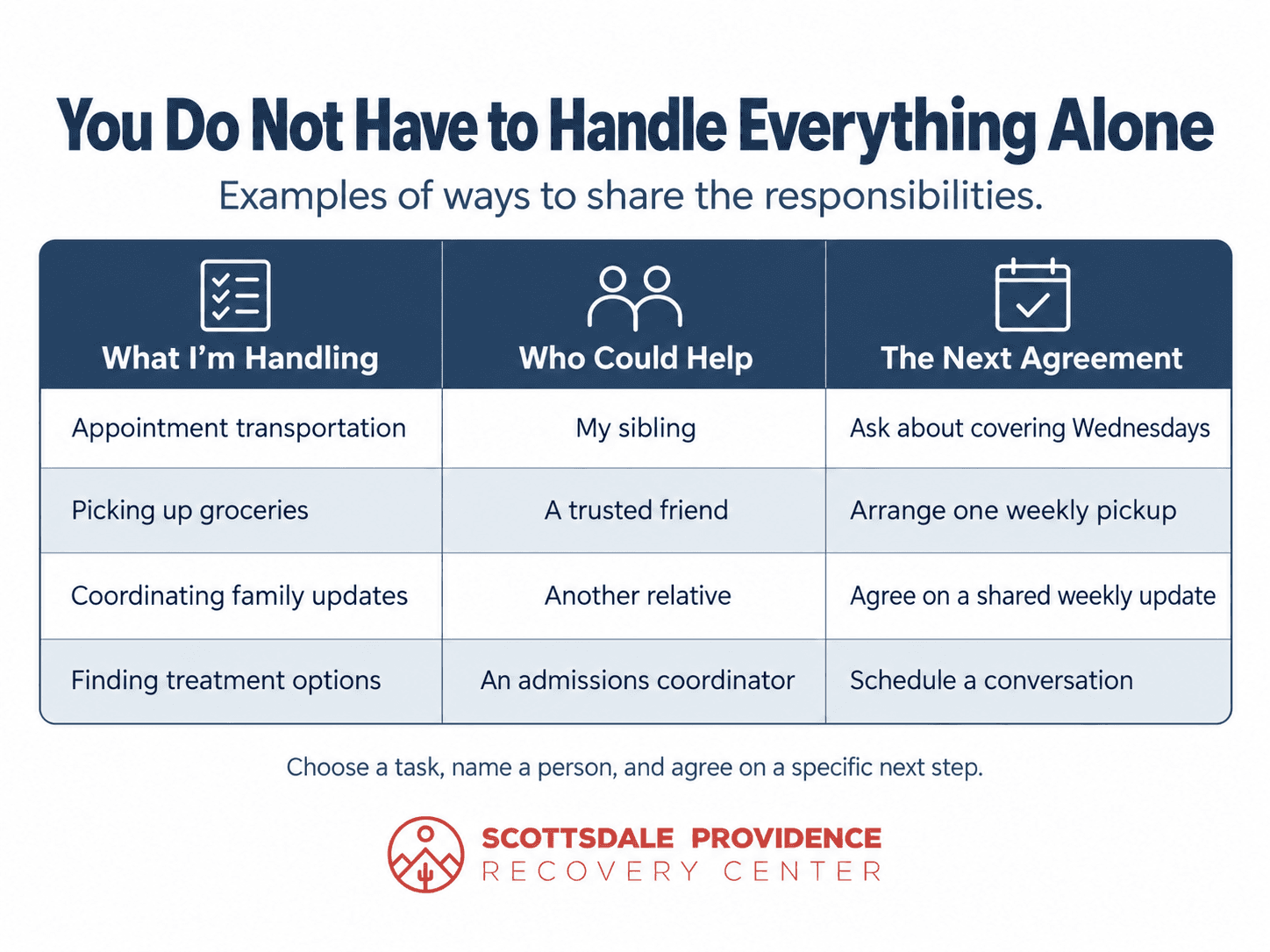
Protect one recurring part of your week. Keep your own medical appointment, arrange a regular meal with a friend, or set aside time for an activity you miss. If coverage is needed, organize it beforehand.
Find somewhere you can speak honestly. Individual therapy or a family support group can give you space to discuss resentment, fear, and uncertainty without making your loved one responsible for those feelings.
Respite, shared responsibilities, and support from others can help caregivers attend to their own health. The right arrangement depends on the care your loved one needs and the resources available.
How Family Therapy Can Help
Caregiver burnout often exists alongside strained communication, unclear expectations, and changes in trust.
Family therapy can help families discuss those patterns, clarify responsibilities, and practice boundaries with clinical guidance. At Scottsdale Providence, family involvement is tailored to the client’s needs and clinical readiness.
That work can create space for questions such as:
- What support is helpful right now?
- What can the family realistically provide?
- Which responsibilities need professional involvement?
- How can we stay connected without repeating patterns that hurt us?
If longstanding family patterns are part of the strain, they deserve attention too. Individual therapy can remain important for caregivers who need a private place to focus on their own well-being.
When the Current Care Arrangement Is No Longer Enough
If you are repeatedly managing situations beyond what you can safely provide, ask for a clinical reassessment.
Changes in symptoms, difficulty meeting basic needs, recurring substance use, or declining daily functioning may indicate that the person you support needs different care. Caregiver exhaustion is also important information about whether the current arrangement is sustainable.
Depending on an assessment, options may include outpatient treatment or a more structured residential setting. When mental health and substance use concerns occur together, dual diagnosis treatment addresses both within an integrated plan.
The appropriate level of care depends on clinical needs and safety, not simply on how much a family is willing to do.
You Can Seek Help Before Your Loved One Is Ready
Your access to support does not have to depend on someone else entering treatment.
Seek professional help for yourself when sleep, concentration, health, work, or relationships are being affected; when alcohol or substance use is increasing; or when you feel persistently hopeless or unable to cope.
You deserve care even if you are still managing the responsibilities in front of you. You also deserve a relationship with your loved one that includes more than checking symptoms and responding to problems.
Find Support for Your Family
Caring about someone does not require carrying every part of their struggle alone. If mental health or substance use is affecting the stability of your family, Scottsdale Providence Recovery Center can help you understand the available options.
Connect with admissions to discuss your concerns and explore the next step toward care.

Author
Victoria Yancer
Victoria writes thoughtful, compassionate content for the behavioral health space. She brings clarity to complex topics and creates messaging that helps people feel informed, understood, and supported as they explore treatment options.

Clinical Reviewer
Daniel Nichols, LCSW
Dan is a Licensed Clinical Social Worker with over 17 years in behavioral health and addiction treatment. His trauma-informed approach blends evidence-based therapies with hope, purpose, and community.
Related articles

Mental Health Screening Month: A Simple Check-In With Yourself
Mental Health Screening Month is a chance to check in. Learn how PHQ-9 and GAD-7 screenings work, what scores mean, and when to seek support.

Anxiety vs Intuition: How to Tell the Difference
Is it anxiety or intuition? Learn how urgency, physical symptoms, trauma, and thought patterns can reveal whether fear or a gut feeling is guiding you.

A Community Honor: Scottsdale Providence Recovery Center Recognized by PHOENIX Magazine as Best Mental Health Facility
Scottsdale Providence Recovery Center, named Best Mental Health Facility in PHOENIX magazine’s 2026 Best of the Valley awards, thanks our community.

Men’s Mental Health Month: Why It Matters and When to Get Support
Men’s Mental Health Month raises awareness around depression, anxiety, trauma, substance use, and suicide risk. Learn the signs and when to seek support.