

Can You Go to Rehab and Keep Your Job?
You may know you need help and still feel unable to step away from work.
Maybe people depend on your income. Maybe you carry the health insurance for your family. Perhaps your job is one of the few parts of life that still feels steady. Or you may be worried that asking for time away will expose something you have worked hard to keep private.
Those concerns are real. They also keep many people waiting until substance use or mental health symptoms become harder to hide and harder to manage.
Treatment does not always require choosing between your health and your career. Depending on your clinical needs and employment situation, you may be able to take protected medical leave, use a reduced work schedule, or attend an outpatient program outside normal business hours.
Can You Go to Rehab and Keep Your Job?
Yes, some people can go to rehab and keep their jobs. Eligible employees may be able to use the Family and Medical Leave Act, or FMLA, for qualifying addiction or mental health treatment.
FMLA can provide unpaid, job-protected leave and continued group health coverage under the same terms. When medically necessary, leave may sometimes be taken intermittently or through a reduced work schedule.
FMLA does not cover every employee or every absence. It also does not erase violations of a consistently enforced workplace substance-use policy. The safest next step is to understand your clinical needs, confirm your eligibility, and plan the leave process before making assumptions about what is protected.
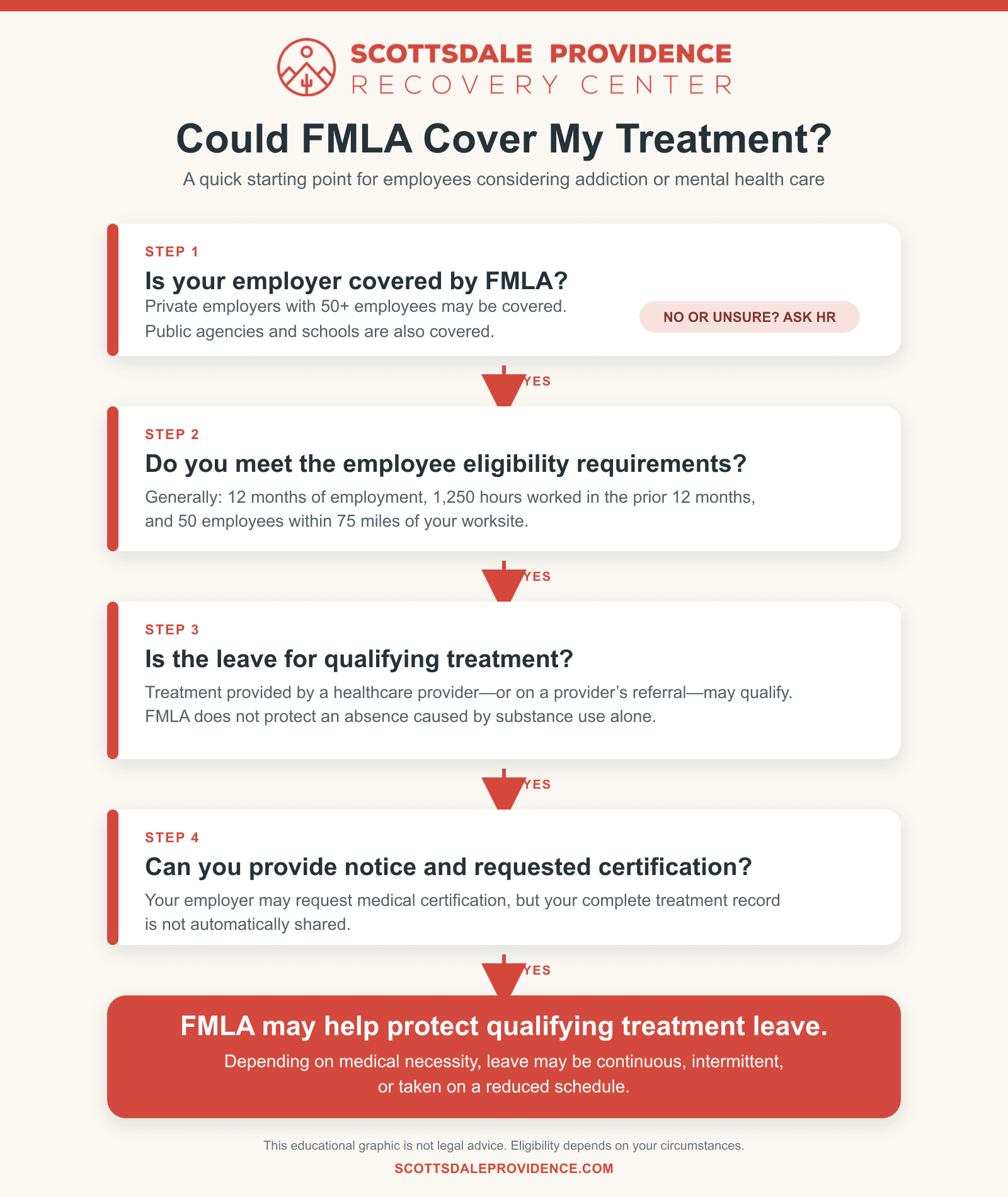
Can You Use FMLA for Rehab?
Treatment for a substance use disorder may qualify for FMLA when it meets the definition of a serious health condition and is provided by a healthcare provider or a treatment provider on referral from a healthcare provider.
That distinction matters. FMLA may protect time away from work for treatment. It does not protect an absence caused by using a substance rather than receiving treatment.
Qualifying care may include:
- Residential or inpatient treatment
- Ongoing outpatient treatment
- Intensive outpatient programming
- Mental health treatment for a qualifying serious health condition
- Medically necessary treatment appointments
- In some situations, care for a covered family member receiving treatment
The U.S. Department of Labor explains that substance use treatment can qualify when the applicable requirements are met.
Every employment situation is different. Confirm your options with your employer’s designated leave administrator, a qualified human resources professional, or an employment attorney.
Who Is Eligible for FMLA?
For many private-sector employees, FMLA eligibility generally requires that you:
- Work for a covered employer
- Have worked for that employer for at least 12 months
- Have completed at least 1,250 hours of service during the 12 months before leave begins
- Work at a location where the employer has at least 50 employees within 75 miles
Different coverage rules apply to public agencies and public or private elementary and secondary schools.
State laws, employer benefits, union agreements, paid leave, short-term disability, or workplace accommodations may provide other options even when federal FMLA does not apply.
Do not assume that being ineligible for FMLA means treatment is impossible. It means you may need to look at a different combination of leave, scheduling, benefits, and level of care.
What Does FMLA Protect?
For an eligible employee taking qualifying leave, FMLA may provide:
- Up to 12 workweeks of unpaid leave during a 12-month period
- Continuation of group health insurance under the same terms that applied before leave
- The right to return to the same job or a substantially equivalent position
- Protection from retaliation for properly requesting or using FMLA leave
- Intermittent or reduced-schedule leave when medically necessary
FMLA protects eligible leave. It does not create a blanket guarantee against every employment action.
An employer may still enforce a substance-use or drug-free workplace policy that is established, communicated, and applied consistently. Certain safety-sensitive roles and regulated industries may also involve additional requirements.
This is one reason timing matters. Asking about treatment and leave before a workplace incident may create more options than waiting until substance use has already led to missed shifts, impaired performance, or a policy violation.
Can You Take FMLA Intermittently for IOP?
Sometimes. When medically necessary, FMLA can be used in separate blocks of time or through a reduced work schedule instead of one continuous leave.
For example, an eligible employee might use intermittent leave for recurring treatment appointments or reduce working hours while attending an intensive outpatient program. The schedule generally needs to be supported by appropriate medical certification. Employees are also expected to make a reasonable effort to schedule planned treatment without unnecessarily disrupting workplace operations.
An evening program may reduce the amount of work you need to miss, but it does not automatically mean you should avoid taking leave.
Early recovery can affect sleep, concentration, energy, mood, and stress tolerance. Some people can continue working safely with evening support. Others need time away or a reduced workload so treatment has enough room to work.
The right answer depends on your symptoms, withdrawal risk, job demands, home environment, support system, and recommended level of care.
Will Your Employer Find Out You Are in Rehab?
Your employer does not automatically receive your complete treatment record because you request medical leave.
An employer or leave administrator may require enough information to determine whether the absence qualifies for FMLA. That can include medical certification describing the need for leave, its expected duration, and whether intermittent or reduced-schedule leave is medically necessary.
A specific diagnosis is not always required, but the certification must contain enough information to support the request.
There is an important difference between your employer knowing you need medical leave and your employer receiving your full clinical history.
Substance use disorder treatment records can receive additional confidentiality protection under 42 CFR Part 2. FMLA rules also require employers to keep medical records confidential and separate from routine personnel files.
Still, privacy is not the same as complete anonymity. If you need time away or a modified schedule, someone responsible for administering leave will know that a medical request exists.
Before submitting paperwork, you can ask:
- Who receives the medical certification?
- What information will my direct supervisor see?
- How are medical records stored?
- Is leave handled internally or by a third-party administrator?
- What documentation is needed before I return to work?
You do not have to tell every coworker or explain your full history to your manager. A simple statement such as, “I need medically necessary treatment and would like information about requesting protected leave,” can begin the process without disclosing more than necessary.
Can You Be Fired for Going to Rehab?
An eligible employee generally cannot be fired because they properly requested or used FMLA leave for qualifying treatment. That does not mean every situation is protected.
An employer may still take action based on factors such as:
- Current illegal drug use
- Using substances at work
- Working while impaired
- Violating an established and consistently enforced workplace policy
- Performance or attendance problems that are not covered by approved leave
- Being unable to perform essential job duties, even with an applicable reasonable accommodation
The Americans with Disabilities Act may protect some people with a history of addiction, people who are no longer engaging in illegal drug use, and people using legally prescribed medication for a substance use disorder. It does not protect current illegal drug use.
These questions are highly dependent on the facts. Legal or HR guidance may be particularly important if discipline, drug testing, professional licensing, or safety-sensitive work is involved.
Can You Work While You Are in Rehab?
“Rehab” can describe several different levels of care. Whether you can continue working depends partly on how much structure and supervision you need.
Treatment option | Can you keep working? | Typical structure | May fit when |
Residential treatment | Usually requires leave | 24-hour support in a residential setting | You need a highly structured environment, continuous support, or separation from an unsafe setting |
Partial hospitalization program | Limited work may be possible | Intensive daytime treatment while living outside the facility | You need substantial daytime clinical support without overnight residential care |
Intensive outpatient program | Often possible with a modified schedule | Structured treatment several days per week while living at home | You are clinically stable but need more support than standard weekly outpatient care |
Evening IOP | Often compatible with daytime work | Structured evening treatment while living at home | You are clinically appropriate for community-based care and need treatment around work, school, parenting, or caregiving |
Standard outpatient treatment | Often possible | Individual or group appointments at a lower weekly frequency | You need ongoing support at a lower level of intensity |
This comparison is a general guide. A clinical assessment is the safest way to determine which level of support is appropriate for you.
Residential treatment
Residential treatment involves living in a treatment setting with continuous structure and support. It usually requires taking time away from work.
Residential care may be appropriate when symptoms are severe, a person needs separation from an unstable environment, or maintaining safety and sobriety requires around-the-clock support.
Partial hospitalization
A partial hospitalization program, or PHP, provides intensive treatment during much of the day while allowing clients to live outside the treatment facility.
Because of the daytime schedule and clinical intensity, PHP may require full medical leave or a significantly reduced work schedule.
Intensive outpatient treatment
An intensive outpatient program provides structured treatment several days per week while clients continue living at home.
Depending on the program schedule and the person’s clinical needs, IOP may work with flexible hours, intermittent leave, or a modified work schedule.
Evening IOP
Evening IOP provides structured outpatient treatment after normal business hours. It may allow clinically appropriate clients to continue working during the day while receiving consistent treatment in the evening.
The most flexible program is not automatically the right program.
If you need medical detoxification, psychiatric stabilization, 24-hour support, or separation from an unsafe environment, trying to preserve a full work schedule can prevent you from receiving appropriate care.
A comprehensive assessment should determine the level of care. Your job matters, but your work schedule should not make the clinical decision for you.
Evening IOP for Working Adults in Scottsdale
Evening IOP at Scottsdale Providence Recovery Center provides structured addiction and mental health treatment three evenings each week for adults who are clinically appropriate for community-based care.
The 10-week program meets Monday, Wednesday, and Thursday from 5:30 to 8:30 PM. Individual therapy is available at flexible evening times to supplement group work.
This schedule can help working professionals, students, parents, and caregivers receive consistent support while continuing daytime responsibilities.
Flexibility is only one part of the program. The deeper purpose is connection.
Evening IOP creates a steady place to be honest, practice skills, receive clinical guidance, and remain accountable while recovery is being tested in everyday life. You do not leave work, relationships, stress, and responsibility outside treatment. You bring those real experiences back into a community that can help you understand them and respond differently.
Evening IOP may be appropriate when you are medically and psychiatrically stable, have safe housing and reliable transportation, and need more support than traditional weekly therapy.
A higher level of care may be recommended when withdrawal, recent substance use, severe symptoms, safety concerns, or instability require greater monitoring and structure.
If evening care is not the right clinical fit, SPRC’s outpatient treatment and inpatient treatment pages explain other levels of support.
How to Start the FMLA and Treatment Conversation
You do not have to solve your employment situation and treatment plan in one conversation. Start by gathering accurate information.
1. Ask for a clinical assessment
Find out what level of care is appropriate before deciding how much leave you may need. An assessment can help determine whether outpatient treatment can provide enough support or whether safety and stability require a higher level of care.
2. Review your workplace policies
Look for information about:
- Medical leave
- FMLA
- Paid time off
- Short-term disability
- Workplace accommodations
- Drug testing
- Return-to-work requirements
- Employee assistance programs
Knowing the written policy can help you separate what you fear might happen from the process your employer actually follows.
3. Contact the right person
The person handling medical leave may be someone in human resources, a benefits administrator, a union representative, or a third-party leave company rather than your direct manager.
Ask who is authorized to receive medical documentation and how your information will be handled.
4. Ask what certification is required
Confirm which forms are needed, when they are due, and whether you will need a fitness-for-duty statement before returning to work.
Missing paperwork or deadlines can create unnecessary complications during an already stressful time.
5. Discuss scheduling honestly
Ask your treatment provider whether continuing full-time work is clinically realistic.
Some people benefit from maintaining an appropriate amount of routine and responsibility. Others need continuous leave, intermittent leave, or a reduced work schedule to stabilize and participate meaningfully in treatment.
6. Keep copies of your records
Save your leave requests, notices, certifications, approvals, and related communication. Keeping everything organized can make it easier to respond if questions arise.
7. Get qualified guidance when needed
If your job is safety-sensitive, licensed, unionized, or already subject to disciplinary action, speak with an appropriate employment professional before relying on general information online.
You Do Not Have to Wait Until Work Falls Apart
Many people delay treatment because they are still functioning at work.
They meet deadlines. They answer emails. They keep appointments. From the outside, they may look dependable and composed. Inside, maintaining that appearance can take more effort every week.
You may be using alcohol or another substance to quiet your mind after work. You may be hiding withdrawal symptoms during the day. Anxiety, depression, trauma, or exhaustion may be making it harder to concentrate, connect with other people, or recover between shifts.
Being able to function does not mean everything is fine.
You do not need to lose your job, damage an important relationship, or reach a visible crisis before asking what treatment could look like. Getting clear information early may help protect more of the life you are trying to hold together.
At Scottsdale Providence Recovery Center, care is built around the whole person. That includes substance use, mental health, trauma, relationships, responsibilities, and the practical work of building stability beyond treatment.
If concerns about your job have kept you from reaching out, one confidential conversation can help you understand the available levels of care, explore scheduling, and verify your insurance.
You can also connect with admissions to discuss what has been happening and what a realistic next step may be.
Frequently Asked Questions About FMLA for Rehab
FMLA may cover qualifying substance use disorder treatment when the employee is eligible and the treatment is provided by a healthcare provider or a treatment provider on referral from a healthcare provider. Absences caused by substance use rather than treatment are not protected on that basis.
FMLA itself generally provides unpaid leave. Depending on your employer and benefits, paid time off, sick leave, short-term disability, or another benefit may run at the same time. Ask your benefits or leave administrator how the policies interact.
You generally need to provide enough information to request qualifying medical leave, but you may not need to give your direct supervisor your diagnosis or complete treatment history. Ask HR or the leave administrator who receives medical certification and what information is shared with management.
It may be used for qualifying outpatient treatment when the legal and medical requirements are met. Medically necessary intermittent or reduced-schedule leave may also be possible. Eligibility and documentation should be confirmed for your specific situation.
Some adults can attend evening treatment while continuing daytime employment. That depends on work hours, commute, symptoms, medical stability, home support, and whether Evening IOP is the appropriate level of care. A clinical assessment should come before the scheduling decision.
During qualifying FMLA leave, an employer generally must maintain group health coverage under the same terms that applied before leave. You must usually continue paying your normal share of the premium.
An employer generally cannot retaliate against an eligible employee for properly requesting or using qualifying FMLA leave. However, FMLA does not prevent an employer from enforcing a consistently applied workplace policy or taking action for reasons unrelated to protected leave. Seek individualized guidance if discipline or termination is a concern. This article provides general educational information and is not legal advice. Employment protections and leave eligibility depend on individual circumstances. Consult your employer’s leave administrator, a qualified HR professional, or an employment attorney for guidance about your situation.

Author
Victoria Yancer
Victoria writes thoughtful, compassionate content for the behavioral health space. She brings clarity to complex topics and creates messaging that helps people feel informed, understood, and supported as they explore treatment options.

Clinical Reviewer
Daniel Nichols, LCSW
Dan is a Licensed Clinical Social Worker with over 17 years in behavioral health and addiction treatment. His trauma-informed approach blends evidence-based therapies with hope, purpose, and community.
Related articles

Stress Awareness Month: The Stress You Feel And The Stress You Carry
Stress Awareness Month highlights how chronic stress impacts your body, mental health, and behavior,and what actually helps you reset and recover.

Drinking After Dry January and Rethinking Your Relationship With Alcohol
Drinking after Dry January can trigger guilt, anxiety, or clarity. This article explains why it feels different and what your reaction may be telling you.

Benefits of Dry January Week by Week: A Complete Guide to a 31 Day Transformation
The benefits of Dry January week by week show real changes in sleep, energy, mood, and health. See how your body restores balance throughout the month.

Supportive Tips for Staying Sober on New Year’s Eve
A sober New Year's Eve can be meaningful and safe. Find supportive, realistic ways to protect your recovery, stay grounded, and enjoy the holiday…